Winter Soups and Bread
Double Dessert
- Heat oven to 425 degrees Fahrenheit. Spray cookie sheet with cooking spray.
- Stir Bisquick mix, cranberries, 1/3 cup whipping cream, 3 tablespoons sugar, the egg, and vanilla until soft dough forms.
- Pat into 8 inch circle on cookie sheet (if dough is sticky, dip fingers in Bisquick).
- Brush circle with additional whipping cream, sprinkle slivered almonds, then sprinkle with additional sugar.
- Cut into 8 wedges, but do not separate.
- Bake about 12 minutes or until golden brown; carefully separate. Serve warm and enjoy!
- Preheat the oven to 350F. Rub a 9 1/2-inch fluted tart pan with olive oil.
- Sift the dry ingredients into a large bowl, pouring any bits of grain or other ingredients left in the sifter back into the bowl. Set aside.
- In another large bowl, whisk the eggs thoroughly.
- Add the olive oil, milk and rosemary and whisk again.
- Using a spatula, fold the wet ingredients into the dry, gently mixing just until combined. Stir in 2/3 of the chocolate.
- Pour the batter into the pan, spreading it evenly and smoothing the top. Sprinkle with the remaining chocolate and run a fork along the length of the chocolate so that the batter envelops it just a bit. Sprinkle with the second sugar.
- Bake for about 40 minutes (even a little less because cake can dry out easily), or until the top is domed, golden brown, and a skewer inserted into the center comes out clean.
- The cake can be eaten warm or cool from the pan, and garnished with whipped cream, fruit (strawberries or raspberries), and some chocolate syrup. Enjoy!
A Mediterranean Meal

- Preheat oven to 350 degrees Fahrenheit (180 degrees Celsius).
- Heat 2 tablespoons olive oil in frying pan. Add onion, celery, and carrot. Cook over low heat for 10 minutes, or until soft.
- Add garlic, cook for 2 minutes, then add chopped tomato, passata, oregano, and sugar. Simmer for 10 minutes, occasionally stirring, until reduced & thickened.
- Stir chopped parsley and lemon juice into sauce. Season to taste.
- Arrange fish in single layer in baking dish. Pour sauce over fish. Scatter breadcrumbs all over the top, then drizzle remaining olive oil over fish.
- Bake for 20 minutes, or until fish is cooked.
- Crumble feta and place in large bowl. Peel and seed the cucumbers, cut into 1/2 inch dice. Add cucumbers to bowl along with the onion and dill.
- Grind mint in a mortar and pestle. Combine with the oil and juice, then season with salt & black pepper. Pour over salad and toss.
Summertime Couscous
- 1/2 cup balsamic vinegar
- 1 teaspoon Dijon mustard
- 2 cloves garlic, coarsely chopped
- 1 cup olive oil
- Salt and freshly ground pepper
- 2 green zucchini, quartered lengthwise
- 2 yellow zucchini, quartered lengthwise
- 6 spears asparagus, trimmed
- 12 cherry tomatoes
- 1 red bell pepper, quartered and seeded
- 1 yellow bell pepper, quartered and seeded
- 1/4 cup basil chiffonade (stack leaves, roll in a cigar shape and cut crosswise into thin strips)
- 1/4 cup coarsely chopped flat-leaf parsley
- 2 tablespoons olive oil
- 1 pound Israeli couscous
- In a small bowl, whisk together the vinegar, mustard and garlic, slowly add the olive oil and whisk until combined. Season with salt and pepper.
- Cut the zucchini and peppers into 1/2-inch pieces, cut the tomatoes in half.
- Pour 1/2 the marinade over the vegetables and let sit at room temperature for 15 minutes. Preheat the grill.
- Remove the vegetables from the marinade and grill the vegetables until just cooked through.
- Follow the instructions on the Near East box for preparation of the couscous itself. Boil 1.25 cups of water (per box of couscous) with some olive oil (optional, but 1-2 tablespoons total recommended) and the contents of the spice packets. When boiling, remove from heat and add all couscous. Cover completely and leave sit (for about 5-10 minutes) until water is absorbed. Couscous is now ready.
- Place in a large serving bowl, add the grilled vegetables and herbs and toss with the remaining vinaigrette.
Homemade Pasta

Ingredients:
Cous Cous Creation No. 1
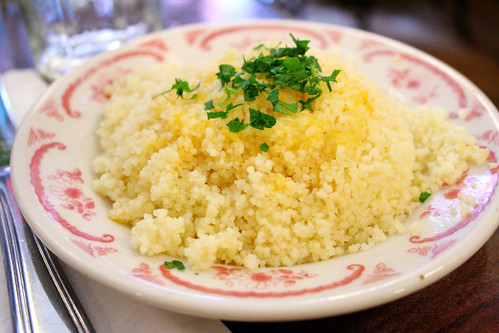
One of my favorite things to make is cous cous. For those who don’t know, cous cous is just a type of pasta from Morocco and northern Africa. It’s so incredibly simple to make and so versatile that you can put almost anything in it to make an amazing dish. Generally, a jar of cous cous is the first grocery item I buy. I tend to just throw together things that I have and this is what I came up with tonight.
Ingredients:
- Meat:
o stew cuts of tender beef (aka beef tips; this is optional and I used pre-cut meat because I try to avoid touching raw meat)
- Cous Cous:
o Equal parts (about one cup each) water and dry cous cous (do NOT mix together)
o About a tablespoon of olive oil
o Diced Roma tomato
o Chopped Onion
o Peas
o Corn
o Basil
o Parsley
Directions:
The meat is optional. So if you’re a vegetarian like 75% of the authors of this blog, skip right on past this part. Otherwise, I just put the beef in a pan, sprinkled some Nature Seasoning on top (although onion and/or garlic powder will also taste good), and cooked it on the stove until well done (personal preference, again).
While the meat was cooking, I put all of the ingredients for the cous cous mix EXCEPT the actual dried cous cous. Bring this mix to a boil, then remove from heat. Now, add the dried cous cous. Cover immediately so that the steam stays inside the pot. Let sit covered off of heat for about 5 minutes, or until the cous cous has absorbed the water.
I cut up the beef and then added into the cous cous dish, mixing everything as I went. I coupled this meal with a mixed greens salad topped with a sliced Clementine orange and a dressing (personal favorite: equal parts balsamic vinegar and olive oil). And cous cous creation #1 with side salad is now complete.
Roasted Eggplant Caponata and Fresh Peach Cake
Paula Deen Strikes Again (Pumpkin Cheesecake)
![]() |
| Our version, with fresh raspberries! |
21 Dangerous & Deadly Dishes
Here is a nice list of interestin
Read the Article at HuffingtonPost
Dinner Conversation
A Tangle in the Loom: WikiLeaks and Iran
The recent thread of WikiLeaks sheds light on a foreign policy problem of nuclear proportions.
In the past week, thousands of important documents and information have been leaked from various U.S. government agencies on WikiLeaks. The leaks are controversial, not only for their sheer number, but for release of cables and conversations between U.S. and very high-ranking officials from other countries. The leaks even prompted Barack Obama to enact new sanctions on Iran today. These sanctions blacklist 10 Iranian businesses connected to the Islamic Republic’s national bank and shipping lines, as well as five executives of these businesses.
On Monday, November 29, 2010, Iranian President Mahmoud Ahmadinejad referred to the leaked documents as “American psychological warfare that would not affect his country’s relations with other nations.” While Ahmadinejad and his administration might be crediting the U.S. bureaucracy with a bit too undeserved organizational skills by calling the leaks “organized to be released on a regular basis,” the leaked documents definitely confirm prevalent theories about the relations between Iran and its Arab gulf state neighbors and its aspirations for regional hegemony.
It is well-known that Saudi Arabia and Iran are vying for regional hegemony, with Iran’s relative conventional military power and sphere of influence giving it a strong edge over the Saudi kingdom. Not only does this allow Iran to influence the trajectories of Iraq and Afghanistan, thus extending its regional influence, its status as a regional hegemon tips the regional balance of power away from Saudi Arabia and other Arab states that have alliances with the United States. Feeling threatened by such expanding Iranian influence even in the face of decades of sanctions, it is hardly surprising that the Saudi regime harbors strong animosity for the Khamenei’s. However, it was previously unknown that the Saudi-Iranian enmity went so far that Saudi Arabian King Abdullah repeatedly begged the United States to “‘cut off the head of the snake’ by launching military strikes to destroy Iran’s nuclear program,” one of the final pieces of Iranian policy that would enable it to secure the role of an undisputed regional hegemonic power. In order to curb Iranian influence, the United States announced in October of 2010 that it will sell $60 billion worth of military aircraft to the Saudi regime.
Saudi Arabia is not the only gulf state feeling pressure to eliminate Iranian challenges to the current balance of power. King Hamad bin Isa al-Khalifa of Bahrain argued in favor of forceful action by any means necessary to eliminate the Iranian nuclear program. Bahrain, a tiny kingdom on the Persian Gulf that is home to the American Fifth Fleet’s naval base, has been feeling Iranian pressure and influence for years. In July of 2007, Iranian advisor to Khamenei Hossein Shariatmadari stated that “The public demand in Bahrain is the reunification of this province with its motherland, the Islamic Iran.” An unnamed senior Omani military official (Oman being the country that helped secure the release of American Sarah Shourd from Evin Prison), is cited in a correspondence as unable to decide which would be worse – “a strike against Iran’s nuclear capability and the resulting turmoil it would cause in the Gulf, or inaction and having to live with a nuclear-capable Iran.” In a December 2005 meeting with American military commanders, United Arab Emirates defense chief and crown prince Mohammad bin Zayed of Abu Dhabi lobbied for American military action against Iran either “this year or the next.” Bin Zayed also expressed fears of a nuclear Iranian state, declaring that “any culture that is patient and focused enough to spend years working on a single carpet is capable of waiting years and even decades to achieve even greater goals.”
While Cenk Uygur, host of The Young Turks, on MSNBC Live is not the best interviewer, the answers provided by Doctors Juan Cole and Trita Parsi in this brief interview are very informative and discuss the fears of changing regional balances of power.
Tensions continue to escalate between these states and power blocs in the Middle East. Yesterday, two prominent Iranian nuclear scientists, both professors at Tehran’s Shahid Beheshti University, were attacked in different parts of Tehran. Assailents on motorcycles managed to attach and detonate magnetized car bombs to the cars of scientists Majid Shahriari and Fereydoun Abbasi, the former killed and the latter injured with his wife. Shahriari was involved in a major project with Iran’s nuclear agency, and Abbasi is a member of the Islamic Revolutionary Guard Corps (IRGC) and listed as one of several involved in secret nuclear activity in a 2007 U.N. resolution. Abbasi was formerly an expert for Iran’s Defense Ministry and a top specialist in nuclear isotope separation. The Iranian regime currently blames Israel and the United States for orchestrating these attacks. Intelligence analysts blame Mossad for the 2007 death of top Esfahan uranium plant scientist Ardeshire Hassanpour. In January of 2010, Massoud Ali-Mohammadi was also killed, but it is unclear whether his death was related to his support of Mir Hossien Mousavi or an Israeli/American operation; he also died in a car bombing similar to that of Shahriari.
The WikiLeaks available thus far clearly confirm the fears of Arab gulf states and seem to perpetuate Israeli public opinion and Netanyahu’s threat perceptions of Iran. In moving forward from the latest sanctions on Iran, the United States must decide how to manage these states’ interests to balance with its own in the Middle East and avoid yet another military conflict that would have, in Barak’s words, “unacceptable collateral damage,” on all sides.
Blog Archive
Bookshelf
- Food of Life: Ancient Persian and Modern Iranian Cooking and Ceremonies; by Najmieh Batmanglij (Author)
- Cuisines of the Axis of Evil and Other Irritating States: A Dinner Party Approach to International Relations; by Chris Fair (Author)
- Paula Deen's The Deen Family Cookbook; by Paula Deen (Author) & Melissa Clark (Contributor)
- The Essential Mediterranean Cookbook; Bay Books